Showing posts with label Asia-Pacific Artists. Show all posts

Monday, March 31, 2008

Natural World Museum

http://www.naturalworldmuseum.org
http://www.naturalworldmuseum.org/exhibitsevents_exhibits_upcoming.html
Natural World Museum
San Francisco, CA 94129
Telephone: (415) 402-0583
E-mail: info@naturalworldmuseum.org

Mia Hanak is the Founding Executive Director of the Natural World Museum, an organization committed to inspiring sustainable culture through the arts in partnership with the United Nations Environment Programme (UNEP). She leads the team that produces the innovative Art for the Environment global exhibition series. She has been nominated by the American Association of Museums as a "Museum Leader for the Next Generation."

Moving Towards a Balanced Earth: Kick the (Carbon) Habit
World Environment Day 2008


For the 2008 World Environment Day, UNEP continues to explore and address the theme of climate change, with an emphasis on moving toward a low carbon economy. Background: The Earth maintains a natural carbon balance. Under normal conditions, the system gradually corrects imbalances and returns to a balanced state. However the rate at which humans are now burning fossil fuels, introducing excesses of carbon into the atmosphere, has surpassed Earth’s ability to maintain balance. As a result, the Earth’s climate has begun to experience massive change.

Nature strives for balance. Carbon balance is one part of nature’s process to maintain stases. Humans, collectively and individually, also strive for balance.

What does it mean to be in balance as individuals and communities? What is the connection between the Earth’s imbalance and our imbalance as a species? Can nature serve as a model and mentor for discovering a way of living in balance, for coming into a state of equilibrium? The excess of atmospheric carbon is just one symptom of our environmental problems; water and air pollution, toxic waste—all of these are also symptoms of imbalance. The symptoms are expressed on both planetary and personal levels. Other species may adapt or become extinct. How will humans adapt?

Participating Artists:
Susan Norrie – Australia
Alison Clouston – New Zealand, Shane Cotton – New Zealand, Bill Culbert and Ralph Hotere – New Zealand, Geoff Dixon – New Zealand,
Walangari Karntawarra – Australia, Ik-Joong Kang – Korea, Susan Norrie – Australia, Jun Nguyen-Hatsushiba – Vietnam,


AES & F Group – Russia, Ken Aptekar – USA, Lise Bjorne – Norway, Lien Botha – South Africa, Antonio Briceno – Venezuela, Enrique Martinez Celaya – Cuba,

Chris Drury – UK, Mounir Fatmi – Morocco, Peter Fend – USA, Isa Genzken – Germany, Ilya & Emilia Kabakov – Russia, Walangari Karntawarra – Australia, Ik-Joong Kang – Korea, Gabriela Morawetz – Poland, Susan Norrie – Australia, Jun Nguyen-Hatsushiba – Vietnam, Susan Plum – Mexico, Ken Rinaldo & Amy Youngs – USA, Alexis Rockman – USA, Harriet Russell – UK, Soledad Salame – Chile, Lars Siltberg – Sweden, Superflex – Denmark, Cyprien Tokoudagba – Benin, Bill Viola – USA

http://www.naturalworldmuseum.org/exhibitsevents.html
Envisioning Change: Melting Ice / A Hot Topic

Lucy + Jorge Orta, Fluvial Intervention Unit


Monaco Installation View

About the Exhibit:

For UN World Environment Day 2007, the Natural World Museum in partnership with the United Nations Environment Programme produced an exhibition that addresses the theme of Climate Change from a global perspective - the melting and thawing of ice, snow and permafrost are environment-altering changes taking place around the world- from the Andes to the Himalayas to the melting ice caps of the Poles. "Change" the transition that occurs from same to different, the moment of transformation, a change of position or action. Change used in reference to our environment can describe the transformation of material substance -- from ice to water, liquid to gas - the changing conditions of our rivers, our rapidly melting glaciers,, and the overall changes in the earth's climate. Change requires organisms and organizations alike to adapt to new environmental conditions. Metaphorically, change can also refer to the transformation of society's mindset to act in a positive way individually and collectively to work toward a more sustainable future.

http://mediazone.brighttalk.com/comm/BrightTALK/282450b2c6-5286-1215-4919

Subhankar Banerjee – India, Ana Prvacki – Singapore, Ichi Ikeda – Japan,
David Trubridge - New Zealand; Yoshiaki Kaihatsu – Japan, David and Hi-Jin Hodge – US & Korea,

Subhankar Banerjee – India, Robert Bateman – Canada, Alfio Bonano – Denmark, David Buckland – UK, Christo & Jeanne-Claude – US, Margaret Cogswell – US, Sebastian Copeland – France, Xavier Cortada – US, Siobhan Davies – UK, Era and Don Farnsworth – US, Free Range Studio – US, Helen and Newton Harrison – US, Mona Hatoum – Lebanon, David and Hi-Jin Hodge – US & Korea, Gary Hume – UK, Laura Horelli – Finland, The Icelandic Love Corporation – Iceland, Ichi Ikeda – Japan, Sveln Flygari Johansen – Norway, Chris Jordan – US, Kahn Selesnick – England, Sant Khalsa – US, Fred Ivar Ultsi Klemetsen – Norway, Angela Lergo – Spain, Jonas Liveröd – Sweden, Dalibar Martinis – Croatia, Jacob McKean – US, Gilles Mingasson – France, David Nash – Wales, Lucy + Jorge Orta – England & Argentina, Sven Påhlsson – Norway, Shana and Robert Parke-Harrison – US, Cecilia Paredes – Peru, Andrea Polli – US, Ana Prvacki – Singapore, Anne Senstad – Norway, HM Queen Sonya of Norway, David Trubridge - New Zealand, Strijdom van der Merwe – South Africa, Theo Wujcik – US, Yoshiaki Kaihatsu – Japan, Justin Young – US.

Monday, February 4, 2008

NZ - Australian -Artist/sites MIC leads

http://www.janineranderson.com/video/001/im2.php
http://www.thebigidea.co.nz/article.php?sid=3779
http://www.media.uoa.gr/yasmin/index.php?method=range&list=message&rollid=942&fromlist=message&frommethod=showhtmllist&fromid=942&offset=25
Art & Climate Change


Art & climat


This project is part of the broader "Cultural Roots of Globlalization" project as climate and meteorology are per se planetary phenomena. Nowadays, many contemporary artists have raised the climate issue. It is possible to speak about an emergent trend within the art scene. Artistic approaches are multiple, going from music to installations, through films and photographies.

Within this project we would like to give a certain visibility to this trend and analyze artistic approaches and perceptions of climate and climate change. We live in a close relationship with climate phenomena but our intimate "weather report" is not always particulary developed. For example, the official weather report at television is of a rather "visual" nature. Therefore, it is possible to state that our meteorological sensitivity is still very rudimentary. Generally speaking, in our western societies the human being seems still to be interested in the weather we have rather than the weather we make. But at the same time contemporary artists and philosophers discover themselves as "pupils of the air" (Herder) and certain western societies begin to integrate the era of renewable energies.

Therefore, the project intends to discuss our experience and sensitivity of climate by developing common cross-questionings and by organizing encounters between artists, writers, philosophers, scientists, engineers.

"Lovely Weather" Project (coming to NZ 18th feb)


  • Editorial committee : John Cunningham, Annick Bureaud, Ramon Guardans, Drew Hemment, Julien Knebusch, Roger Malina, Jacques Mandelbrojt, Andrea Polli and Janine Randerson.

  • Contact : leonardolovelyweather@gmail.com

  • Partners : Centre culturel régional Letterkenny (Irlande) : http://www.donegalculture.com/


  • Adam Hyde, Julian Priest
    http://www.dlux.org.au/
    http://dlux.org.au/dart07/
    http://www.physicsroom.org.nz/gallery/2008/ageekosystem/
    http://www.radio-astronomy.net/partners.htm
    http://www.radioqualia.net
    Radio Astronomy is a collaboration between: - r a d i o q u a l i a, New Zealand
    - the Windward Community College Radio Observatory (WCCRO) in Hawaii, USA
    - NASA's Radio Jove network, USA
    - the Ventspils International Radio Astronomy Centre (VIRAC), Latvia.

    http://www.ntticc.or.jp/Archive/2005/Opennature/Talk/talk01.html
    part of open nature

    http://www.aotearoadigitalarts.org.nz/links/Artists/
    The ADA Digital Arts Network
    Aotearoa Digital Arts is New Zealand/Aotearoa�s only digital artists� network, The list was launched in 2003 by Stella Brennan and Sean Cubitt during Brennan�s stint as inaugural Digital Artist in Residence at Waikato University�s Screen and Media Department.
    http://www.asci.org/
    art and science

    Friday, February 1, 2008

    NZ: Wild Creations Artists in Residence programme

    The Department of Conservation and Creative New Zealand
    launched the Wild Creations Artists in Residence programme in 2002-07.
    The programme provides New Zealand artists with an outstanding opportunity to experience the people, stories and challenges associated with our country’s unique natural and historic heritage.

    Louise Potiki Bryant
    Louise Potiki Bryant, a choreographer and video artist based in Piha and of Ngai Tahu descent, will spend six weeks at Mt Cook / Aoraki.
    She plans to develop a work integrating dance, video and sculpture which will go on to be performed live as a solo dance work.
    She would also like to produce a short dance film from footage shot of this work as it is performed at Aoraki.

    Naomi Lamb
    Inspired by the Nikau coast and the Heaphy track after first walking it in 2000, Christchurch based new media artist Naomi Lamb will head for Karamea in April with the intention of capturing the essence of the spectacular landscapes and coastal bush in the region and exploring the unique cultural heritage of travel by foot for taonga, food, exploration, trade, settlement and now leisure. She will extend her skills in video to create a immersive sensory video installation.

    Alison Isadora
    Audio artist and composer Alison Isadora, formerly of Wellington but now based in the Netherlands, intends to spend time in Bannockburn, Central Otago collecting sound material to produce a collection of songs. She will also collect images of the river and create an interactive performance piece or installation.
    Zoe Roland

    Zoe Roland's
    Christchurch film-maker Zoe Roland's residency commenced in June 2003. Zoe stayed at Tiritiri Matangi Island in the Hauraki Gulf to record a video about the island’s flora and fauna. She is an experimental documentary film-maker and her work deals with themes of memory, preservation, storytelling and experiences of the New Zealand landscape.
    For further information or interviews with the artists, please contact:
    Cushla Managh
    Senior Media Officer
    Department of Conservation
    Tel: 04-471-3117 or 0274-846-810

    Iona McNaughton
    Writer, Communications and Advocacy
    Creative New Zealand
    Tel: 04-498 0715


    Friday, January 25, 2008

    AND - Artists Network Database

    Archive for the '.News' Category

    Announcement

    In short, The Network ([NewMediaArtProjectNetwork]:||cologne) will start AND - Artists Network Database, a new component in the framework of The Network. Its purpose is to centralize and concentrate information which forms the basis of all projects and environments initiated and realised by The Network, i.e. the biographical info of the involved artists.

    This database will be installed primarily for internal use, but it is available online with free access und open for all people interested in media art on a global level.

    Since 2000 more than 1000 artists joint the activities of The Network , and through the new database the continously changing artists information can be organised and updated more effectively.

    http://intercreate.org/ian

    http://www.newmediafest.org/blog/

    http://www.a-virtual-memorial.org/blog/

    http://www.javamuseum.org/blog/?page_id=33
    I - Ocean
    -netart from Asia and Pacific area
    netart showcase launched in 2004
    http://www.javamuseum.org/2004/asiafeature/index.html

    .
    selected artists
    the names are linked withe biographies
    .


    Nancy Mauro-Flude (Australia)

    nancy@sistero.sysx.org
    nancy@eclectictechcarnival.org
    + 31 6 24105857
    http://sistero.sysx.org

    media artist / dance / installation / hacker of narrative and western medicine
    mostly appears under the name of “sisterO”. An unlocatable mesmeriser who conducts digital media divinations in order to mobilise messages from the underwater database of subjugated knowledge’s. Contributes to urban mythology, virtual kinship communities and new narrative architecture in multinodal, networked experiences which look at the glitches, interferences that come with the hacking of narrative and codes. sister O is a border line dancer and writer, creates zones of collective regenerations in the form of ’sister O Operations’. In 2003, recipient of a Australia Council for the Arts - new media artist residency Conducted a 3 month empirical research in sibundoy, cabildo indigena kamentsa putomayo sth. Colombian jungle - exploring ancient media of sound, dance, plants and divination. Artist residency at Sensing Presence lab: a division of Waag society of / old and new media in Amsterdam the in-house developers of KeyWorx. [This was part of Dasarts Field work]. Former scholar of the Department of Performance studies {honours 1:1} The University of Sydney and at the Institute of Somatic Movement Studies: Amsterdam.


  • Ian M Clothier (New Zealand)
  • Ian M Clothier/the District of Leistavia

    Ian M Clothier
    Collaborators for ISEA 2004 Constitution project:
    Kylli Mariste
    Joe Flynn
    Brendon Mills (php author)

    Collaborator for ISEA 2006 project
    Scott Blinmann (php author)
    In 2006 he co-organised the international and national residency SCANZ

    Thursday, January 24, 2008

    Digital Media - Japan/Singapore

    http://www.ycam.jp/en/art/index.html

    YCAM invites media artists from Japan and abroad to produce new pieces of art, and presents these commissioned works at its exhibition facilities. Within the realm of interdisciplinary creative work encompassing art, science and information technology, we put emphasis not only on visual art, but on sound and software art as well. YCAM's "InterLab" department generally co-produces works together with artists, and assists them with program development, research, and the design of hardware and interfaces. The results are then applied and further developed in YCAM's educational programs.


    Ryoji Ikeda presents new and existing works from his datamatics series.
    The
    datamatics series is a long-term programme of moving image, sculptural, sound and new media works that take data as their theme and material, exploring the ways in which abstracted views of reality - data - are used to encode, understand and control the world.

    Ikeda's works both examine and apply mathematical and scientific theory, and test the extreme potentials of digital technology, to reveal the microscopic matter - and data - that permeates our universe, whilst challenging our own thresholds of perception.

    This solo exhibition presents the recent works data.film [nº1-a] and data.tron, alongside a major new installation commissioned by YCAM, entitled test pattern [nº1]. The exhibition opens with a live performance of Ikeda's critically acclaimed concert piece datamatics [ver.2.0].


    http://archive.ycam.jp/#

    gravicells

    Official WEB SITE
    2004-5-152004-6-20
    Seiko Mikami / Sota Ichikawa


    Representation about the gravity used as a background
    Text by Seiko Mikami + Sota Ichikawa

    In the center of the installation space is a 6m x 6m floor with a built-in sensor. The moment a participant stands and moves on it, the variation of his or her position, weight, and speed is automatically and continuously measured, analyzed, and reflected on light, sound, and image, generating substantial spatial changes. Overlapping the real space, this simultaneous imaginary space reconstructs the spatial geometry, and distorts the coordinates through the participant's weight and position.

    On the floor screen is projected a grid image to measure density. It constitutes the geometry that generates and modifies in real time the coordinates linked to the participant's position and movements. In addition, the body index is represented by both the multi-channel sound degree and a level line created by LED light, and set on one's eye level. Through this continuous data in the light change and sound direction, the space changes.

    The place of the installation is simultaneously surveyed by GPS satellites, so it has the observatory point outside the earth. It expands our area of perception, and reveals that the installation site itself is no longer static but always moving by gravity in relativity. The installation provides us with a device to sense the possibility of the dissolution of gravity, which has multiple meanings.

    http://www.jaist.ac.jp/ks/labs/nagai/prof/nagai/index-e.html

    http://www.jaist.ac.jp/is/index.php
    Japan Advanced Institute of Science and Technology 

    YUKARI Nagai

    What is the creativity in design?

     The research goes on with the Process of Design's Creative Thinking. The way of this research adopts the method of experimental observation as core in cognitive science, semiotics as axis in visual language analysis.

     The research field also connects with others: the visual creativity activities of Communication Design, Architecture Design, Visual Art, Modern Art, Cartoon, and others, Conceptual Art, Molding expression and education, learner's support.
     If you get interested in study with the fields of design, art, architecture, visual / dynamic / sense expression and other undeveloped human's creativity, please make a visit to this laboratory at once by all means.
     We make a study of how they are produced.
     It is considered that study is also one form in which human's creativity is expressed.


    http://www.jaist.ac.jp/ks/labs/nagai/english/index.html
    Mechanism of Decision Making

    Research Field
    The research is on the Process of Creative Thinking in Design, Design Semantics, Theory of Design Expression, and Visual Communication Design.
    Laboratory's Introduction

    NAGAI Laboratory is the purpose of research with creative process in design and various kinds of fields. The study of personal creativity in society, the method of design in circulative society, the work of art's creative process, creative engineering, polysemy of architecture , the creativity in literature, creative education, scientific and mathematical education …the subject of everyone's study is manifold. However, as possible to catch really in the process of creativity is the common posture. It is necessary to discuss repeatedly because the field of methodology in creative research has not established yet. While the opinion disputes gradually, each member aims at the advanced result and goes forward in his/her field.

    Contact address:
    YUKARI Nagai
    Address : 1-1, Asahidai, Tatsunokuchi, Nomi,Ishikawa, Japan 923-1292
    Japan Advanced Institute of Science and Technology 
    School of Knowledge Science Mechanism of Decision Marking
    Nagai Lab.
    Tel: 0761-51-1706

    http://www.ntticc.or.jp/Exhibition/2007/SilentDialogue/index.html

    Nature and the environment that surrounds us are in constant change. To turn our attention to the behavior of other living things as the environment changes is to realize the effects on ourselves, living in that same environment, and that we are all linked in a single ecosystem. In other words, we are constantly receiving messages from the very environment we inhabit.

    Plants and animals form closed systems that interact with the natural environment to acquire information and maintain the equilibrium of their internal environments through homeostasis. By examining the natural environment from the point of view of the plants and animals that inhabit it, we can pinpoint the environmental data they gather with the various sensors they possess. The world seen in this way may be totally different from the one we human beings perceive. By investigating how plants, animals, or insects communicate with each other, by exploring their ecologies and their behavior towards each other, we discover new perspectives on how human beings can relate to them as well.

    This exhibition, then, focuses on this "invisible communication." The works presented explore our relationships with the natural environment through making it visible or audible, based on biological information, thanks to uses of biosensors. The exhibition also uses computer simulations of the natural environment in an effort to explore new conceptions of the environment these technologies reveal.

    Artists/Works:

    FUJIHATA Masaki + DOGANE Yuji - “Botanical Ambulation Training”;
    by Japanese media artists Masaki Fujihata and Yuji Dogane, which moves plants in three dimensions, monitoring their conditions through microsensors.
    Orchisoid 03, 2003, by FUJIHATA Masaki + DOGANE Yuji
    In Orchisoid 03, Dogane Yuji worked with renowned digital media artist Fujihata Masaki (some of his previous works include Unreflective Mirror and Beyond Pages) to better understand adaptation and homeostasis in plants. For this project, several orchids were again wired and set to experience a variety of vibrations from the shifting table they rest upon. The artists concluded that the physiology of the plants changed the same way as human brain wave patterns change in response to stress. And because the orchid’s wave-activity fluctuates in real time, rather quickly, Dogane recognized it as a sign of high-level information processing.


    FUJIEDA Mamoru + DOGANE Yuji - “Paphio in My Life”;
    Dogane Yuji, a botanist who has focused his research on orchids, collaborated with composer Fujieda Mamoru for Paphio in My Life, where the inaudible sounds of plants are picked up by connected wires then converted to manifest a plant’s ‘voice.’ As plants respond to environmental stress, simulated by varying vibrations induced by the artists’ algorithmic program, the plant’s ‘voices’ vary accordingly. By broadcasting such a dialog, Dogane hopes to bring us closer to plants through this glimpse into their life.

    Christa SOMMERER & Laurent MIGNONNEAU - “Interactive Plant Growing”;
    Also on display were Christa Sommerer and Laurent Mignonneau's installation Interactive Plant Growing from 1992. Touch the plants and watch the screen fill up with a digital cascade of the plant’s leaves; still a great example of physical action into digital realization.


    Lois & Franziska WEINBERGER - “Home Voodoo I”, “Home Voodoo II”, “Datura stramonium”, Documentary film “Das Leben will leben: Die Kunst der Weinberger”;

    Michael PRIME - “Ha, Ha! Your Mushrooms Have Gone”;
    by British sound ecologist Michael Prime, which shows the bioelectricity of shiitake mushrooms in the form of sounds that change as the viewers move around the gallery;
    For a glance into the secret lives of mushrooms, Michael Prime affixed bio-sensors to various kinds of locally grown mushrooms to reveal a dialog we perhaps thought never even existed. From their docile setting in an aquarium, the bio-receptors broadcast the sounds of pulsating waves of noise through speakers in the installation space. The result- a surprising continuous drone that shifted tones rather sporadically revealing a brash, trance-like state of mushrooms- fascinating, surreal and surprising.

    ANDO Takahiro - “Bio Photon : Allelopathy”;

    One of the most interactive works displayed was Bio Photon: Allelopathy by Ando Takahiro. As plants germinate and grow, photons are emitted from their leaves. They are invisible to our eyes but in his work Ando work visualizes the amount of photons via the discreet sensors which results in a hyper-sporadic display of flickering lights across the dome at light speed, if you will. Ando has intentionally set up two electric-current-generating for us, which upon touching, allow us to feel the currents that we couldn’t otherwise visualize.


    tEnt (TANAKA Hiroya + CUHARA Macoto); “Call ⇔ Response”; Listening room.


    Other Exhibitions and Events are opening:

    Open Space
    Open Space 2007(Parmanent Exhibition)
    | >Details |
    Organizer : NTT InterCommunication Center[ICC]

    ICC aims to create an environment where one encounters and engages with the progressive experimental activities derived from the dialogue between technology and art.
    http://www.ntticc.or.jp/Exhibition/2007/Openspace2007/art_technology/index.html
    Art & Technology Zone
    Art & Technology Zone is an exhibition area where one can investigate the dialogue between technology and art. It presents an overview of artistic expression within information society and its context while also surveying changes of artistic style, era and social order.


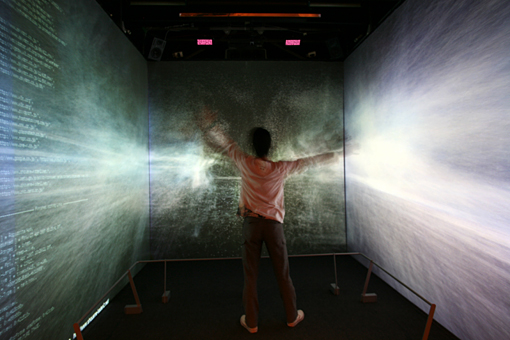
    Big waves surge in a screen-filling computer-generated ocean. When you move, as if crawling through the waves of information generated from the data, you see a link emerging between the waves. The next website is determined by the conditions of the waves, and new waves of data rush towards you again.

    These abstract waves are generated by downloading content data, which is supposed to be viewed on browsers in the intangible and virtual space of the Internet, as a sequence of numerical data. This work accesses the Internet without the interfaces we usually need to see websites, such as a mouse, keyboard, and browser. The term "net surf," which refers to the act of visiting and viewing websites, is a physical metaphor that reminds us of actual space. In this work, we literally move our body to access to the information space of the Internet and, as the title suggests, drift through the Internet.
    HIRAKAWA Norimichi uses computer-programmed interactive expressions in his works to enable people to grasp phenomena that they can hardly recognize in their daily life, on a gigantic scale, and experience them by using intuitive interfaces. His works are triggers to stir the imagination, with devices to help us towards new perceptions of our daily life and to recognize the world afresh.

    See Detail

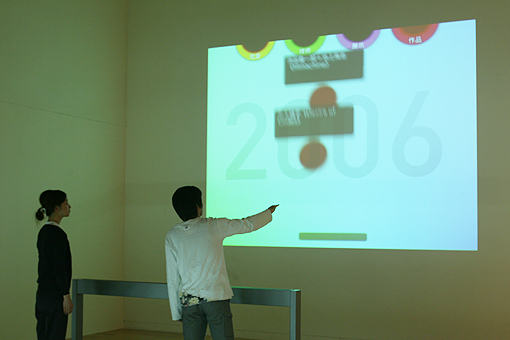
    Interactive Chronology
    This interactive chronology presents key works and exhibitions of media art after 1991 in conjunction with social and technological trends.
    See Detail

    Tsunamii.net
    www.tsunamii.net

    Formed in 2001 in Singapore tsunamii.net by artists,
    Tien Wei Woon (*1975 Singapore) and Charles Lim Yi Young (*1973 Singapore) and
    Scientist, Melvin Phua (*1975).
    Since then the theme of internet and geography has been prominent in their series of work, alpha series.


  • SoiiZen Art Labs (Taiwan)
    www.soiizen.com
    consists of: Yu-Chuan Tseng, Chia-Hsiang Lee
  • information ME
  • Information ME , 2007
    Information ME create digital portraits of being nowadays. In the process of representation, participant’s face will be replaced and reconstructed by information of SMS and on-line news in real time.
  • Flow, 2006
    When the internet becomes our resource of information, we try to fetch the news as many as possible from the net. The work ‘Flow’ is an interactive art work creating a context of flowing information which is unable to be hold and instead of intermix.

    ACM Multimedia 2006 Conference, Interactive Art Program,short paper, 2006.10.23-10.25

  • Let's Make ART, 2003
    "Let's Make Art" is an attempt to create art in real time by inviting interaction with different artists through the internet and in this way to reconsider the meaning of art in the technological age.


  • Australia + NZ ARTISTS (Keith Armstrong)

    Keith Armstrong


    http://www.embodiedmedia.com/
    This is both an archive of past artistic works and an ongoing record of Keith Armstrong's individual and collaborative new media, hybrid arts and arts research practices. Australian

    http://www.embodiedmedia.com/projects/IT/philosophy.htm
    Intimate Transactions
    Intimate Transactions is inspired and directed by an examination of what Dr. Liz Baker calls ecological subjectivity; a sense of self that is intimately relational, embodied and embedded.

    "We live under the enduring mantle of a global crisis, a self-imposed act of unparalleled and seemingly irrational self-destruction which we misname as ecological - we are the crisis. Numerous contemporary theorists have suggested that this 'problem of ecology' indicates a crisis of human subjectivity (understanding of self) and agency (how we choose to act), suggesting a fundamental problem in how we image ourselves within the world."
    Dr. Keith Armstrong

    Intimate Transactions is hence underpinned by ideas synthesized from theories of critical ecology, ecological subjectivities and the systemic flow of energy and matter within scientifically defined ecologies. It therefore questions how might principles of ecological science and philosophy lead to the evolution of new forms of process, practice and outcome in the media arts. These key ideas have long steered director Keith Armstrong's work.

    To achieve this Intimate Transactions brings together, explores and dissects ideas and practices from the media arts, interactive design, performance, telematics, interactive sound-scape design, custom electronics, furniture design and alternate human-computer interfaces.
    Installation processes data from the body - Intimate Transactions is a new type of interactive installation that allows two people located in separate spaces to interact simultaneously using only their bodies. As this highly immersive experience evolves, each participant begins to sense their place in a complex web of relations that connect them, and everything else within the work.

    Cardiomorphologies (2004-7)

    http://www.georgekhut.com/biofeedback/cardiomorphologies/movie/
    (Sydney based team)
    14-21 September 2005

    Cardiomorphologies, by George Khut et al.Cardiomorphologies is an interactive installation that uses bio-sensing and multimedia technologies to create real-time visual and sonic representations of the audiences breath and heart rate. Participants interact with the work one person at a time through heart and breath sensors. During their interaction participants are encouraged to use the work as a feedback system to observe and experiment with their own breath and heart-rate patterning.

    Cardiomorphologies takes as its subject matter and material, the participants own psycho-physiology, allowing them to reflect on the physically and emotionally mediated nature of our actions and perceptions through a gentle but highly focused process of observation and interaction. The work examines some of the ways in which different kinds of mental activity impact on our physiology and conversely how particular heart and breath patterns seem to entrain certain kinds of feelings and perceptions.

    About the creative team

    George (Poonkhin) Khut is an artist working in the area of sound and immersive installation environments. He is researching a Doctorate of Creative Arts at the University of Western Sydney, Australia, in the incorporation of biofeedback training technologies with interactive music and sound environments. The development of Cardiomorphologies has been supported by Performance Spaces Head Space artists residency program.

    Lizzie Muller is a curator specializing in interactive artwork. She is currently researching audience experience of interactive art for her Ph.D. at Creativity and Cognition Studios, University of Technology, Sydney. She is the curator of Beta_space.

    Greg Turner is an interaction designer who specialises in creativity support. He is currently developing flexible software tools for artists for his Ph.D. at Creativity and Cognition Studios, University of Technology, Sydney.

    Alex White is an artist working in the fields of experimental audio and improvised performance. Alex lives in Sydney and is completing his Honors in Electronic Arts at The University of Western Sydney.

    HYBRID ART

    SymbioticA:

    The Art and Science Collaborative Research Laboratory,
    University of Western Australia, Perth
    (represented by its co-founder and Artistic Director Oron Catts) (AU)

    new window: www.symbiotica.uwa.edu.auwww.symbiotica.uwa.edu.au

    Located at the School of Anatomy & Human Biology, University of Western Australia SymbioticA is an artistic laboratory dedicated to the research, learning and critique of life sciences. SymbioticA is the first research laboratory of its kind, in that it enables artists to engage in wet biology practices in a biological science department.

    SymbioticA sets out to provide a situation where interdisciplinary research and other knowledge and concept generating activities can take place. It provides an opportunity for researchers to pursue curiosity-based explorations free of the demands and constraints associated with the current culture of scientific research while still complying with regulations. SymbioticA also offers a new means of artistic inquiry, one in which artists actively use the tools and technologies of science, not just to comment about them, but also to explore their possibilities.


    Feed
    a garden raised by television
    by shane cooper (currently living in NZ, Wellington)
    shanecooper@shanecooper.com - sent email no reply

    Description
    The work is composed of two halves. The upper half is a video wall of television screens, each tuned to a different channel and playing at low volume. The lower half is a garden of ferns that can survive under conditions of extreme lighting. The television screens provide light to the plants, which grow towards them in a constricted space, eventually colliding.

    The video wall has also been run from live feeds - infrared cameras installed in the gallery space. In this case, the garden survives on the presence of people, as infrared cameras convert images of visitors into visible light. "Feed" is part one in a series of four, and this subject is further explored in the second work "Light of Life".

    Feed: interactive installation to show how life is fed by media - According to Pier Luigi Capucci, nowadays the relationship between arts and life follows two different paths. The first and more ancient is deep-rooted in the organic matter and is inspired by scientific disciplines: biology, biotechnology and genetic. The second path, more recent, comes from different approaches: artificial life and robotics. The essential difference between the two (apart from tools, approaches and technologies in use) is that in the first path life is presented as it is, while in the second it is represented, i.e. simulated. Shane Cooper’s installation Feed, recently displayed at Museum of Contemporary Art Taipei’s Zone_V2_ Unstable Media, combines the two paths. The work is composed of two halves.

    EKTA: A Sensory Awareness Installation

    http://www.spark-envision-media.com/home.html
    by Ashanti Vivia and Chris Korda (AMERICAN)

    EKTA is an interactive multimedia and biofeedback installation that allows a user to control light and sound directly with their brain waves. EKTA mirrors the user's brain state, allowing them to mentally program many aspects of the experience, in real time. The user wears a special EEG headband, which radios their brain waves to a network of computers. The computers respond with synthesized algorithmic music, and a video projection of continuously morphing kaleidoscopic imagery, both of which follow changes in the user's brain waves. For example, as the user relaxes, the music gets slower and deeper, encouraging them to relax even more (positive feedback). The experience leads the user through seven distinct stages, which correspond to the seven chakras (energetic centers) of the human body. Each chakra is represented by a unique color, geometry, bass note, and change of musical instrument.

    EKTA is the Sanskrit word for UNITY. EKTA allows the user to experience the unification of their inner and outer vibrations. The goal of this heightened awareness is transcendence, a state in which they see things as they really are. As with many meditative and spiritual practices, this has the potential to bring about internal transformation.

    Ashanti Vivia and Chris Korda
    Artists have worked in America - but bouncing of Eastern Culture
    Shifting our state of awareness can be a powerful tool. In many Asian cultures this observation is still practiced in daily life. It is in the study of different cultures through video art I seek to explore as a tool for teaching. I seek to understand what influences one another and how our actions are connected. By weaving together the everyday and the sacred I look to generate examples from my travel footage. This is executed through experimental documentary montage. My emphasis is on showing the juxtaposition of meditative acts in temple life to transitions of everyday city life. I have captured footage of a monastic and city life in India, Thailand, and Cambodia. While also including rhythmic scenes from the streets of American life I represent a comparable thread that may unite the pulses of daily activities to a sacred intentional force. These images explore an interconnectedness of consciousness from around the globe.


    http://www.sonicsfromscratch.co.nz
    http://www.sonicsfromscratch.co.nz/visual.php
    Philip Dadson (NEW ZEALANDER)
    Polar Projects 2003-6
    http://www.sonicsfromscratch.co.nz/dadsonics.php?id=4


    Seven video/sound works make up the series: Echo-logo, Aerial Farm, Stone Map, Flutter, Arc, Chthonion Pulse & Terra Incognita - an interactive 3 screen work devised in association with James Charlton. One audio work, Stone,Water,Air,Ice was devised as both radiophonic and headphone piece, related to the video works.


    Polar Projects is a body of work produced by Philip Dadson during his 2003 Artist Fellowship in Antarctica. The exhibition explores Antarctica’s extraordinary Dry Valleys through a unique selection of sound and video works, along with a suite of rock drawings that record the surface of the stones and boulders of the Dry Valleys. Dadson’s vision of Antarctica challenges our perceptions of this unique environment in this subtle, playful investigation into the sonic properties and visual polarities of this landscape.

    In Flutter, a single red flag is battered by a howling wind producing interesting tonal effects and creating a poetic display of Antarctica’s intense environmental affects. Similarly, Aerial-Farm presents an aerial-mast with multiple wires that are activated by the wind, producing an intense phonic resonance as the image fades in and out through the interference of the snow storm.

    Mostly the valley seems silent, with only a background hiss of pink noise to accompany the intrusive sounds of my body, my footsteps. No bird or animal noises, only occasional ice snaps and explosive retorts from the splintering glacial-face and the lakes of frozen seepage from the melt

    (Extract from Philip Dadson’s diary written while in Dry Valleys, Antarctica, January 2003)

    Philip Dadson is a sound and intermedia artist based in Auckland. He is the founder of From Scratch, an innovative rhythm/performance group and has exhibited and performed widely in New Zealand and internationally. In 2001, Dadson was awarded the New Zealand Arts Foundation Artists Laureate.

    Polar Projects shows at The Physics Room from 19 January - 19 February 2005,


    http://www.antarcticanimation.com/content/about/about.php
    Lisa Roberts, Candidate for PhD, College of Fine Art,
    University of New South Wales, September 2007
    The certainty of change:
    Antarctic animation

    How can animation be used to reveal the profound human connections
    that some have made with Antarctica's changing landscape?
    This is a work in progress - the site of an arts-based inquiry being undertaken by Lisa Roberts, candidate for PhD, College of Fine Arts, University of New South Wales (2007-2009).
    Animations are being made in response to Antarctic landscape,
    and to scientific and poetic texts provided by expeditioners
    who have measured and experienced its changing nature.

    Events | Exhibitions | Screenings
    2007Antarctic Midwinter Festival exhibition, screening, Hobart
    2006Changing Nature (Greenpeace Australia Pacific), Sydney
    2006Antarctica is Melting, m.a.d., Sydney
    2005Antarctica - the experience, Mura Clay Gallery, Sydney
    2005Artist in Residence Retrospective, Scotch Oakburn Centre of Visual and Performing Arts, Tasmania
    2004Antarctic Journeys - Meadowbank Gallery, Tasmania.
    2004Icemelt, Antarctic multimedia installation, Mura Clay Gallery, Sydney
    2004Antarctic artifacts, Mori Gallery, Sydney
    2004Icemelt - Antarctic multimedia installation, s.p.a.c.e. gallery, Launceston

    2002- 04Icemelt

    An animated film and an interactive work on CDR-OM (42 days in Antarctica)
    An installation of Antarctic art work in mixed media developed on a Fellowship with the Australian Antarctic Division and funded by the Australia Council's New Media Fund. 2004
    2002- 03Imagining a Different View

    An animated Antarctic Journal on CD-ROM. Author/Producer. Commissioned by the Australian Antarctic Division, 2003.

    Interrogating the Invisible

    by Ian Malcolm Clothier
    (Western Institute of Technology at Taranaki, New Zealand)
    :
    In this project, the Leistavian Federal Bureau of Information is gathering statistics and information about how people identify with their culture. It is also interested to know whether there are any differences between people with one cultural identity and those with two. The information was collated and presented visually initially as part of a project for the 13th International Symposium on Electronic Art in San Jose, and then at other exhibitions. All information is strictly confidential.

    International Symposium on Electronic Arts/Zero One [ISEA 2006] San Jose
    Quest for success C5 contestant ISEA 2006/Zero One

    Finger Lakes Eco Film Festival (online category) Cornell University USA


    Wednesday, January 23, 2008

    information aesthetics/doubleNegatives Architecture Japan

    autonomous architecture

    http://corpora.ycam.jp/en/online.html
    Corpora in Si(gh)te

    Virtual architecture grows in accord with the environment.


    http://corpora.ycam.jp/en/online_071201_01.html
    1. map of environment data from mesh network in YCAM & the central park

    http://corpora.ycam.jp/en/online_080101_02.html
    2. analytic image of sky above YCAM
    Corpora in Si(gh)te doubleNegatives Architecture

    http://doublenegatives.jp/
    time: April 29(fri) -- July 3(sun) 2005
    group exhibition "Open Nature"
    location: NTT Inter Comunication Center Tokyo


    autonomous architecture

    16 January 2008

    corpora_main.jpg

    Organizer: Yamaguchi City Foundation for Cultural Promotion
    Support: Embassy of Switzerland, Embassy of the Republic of Hungary in Tokyo, Yamaguchi City, The Board of Education of Yamaguchi City
    Special Cooperation: University of the Arts Zurich (ZHdK), Department Interaction Design, Zurich Switzerland, Nextlab, Budapest Hungary
    Cooperation: The Asahi Shimbun
    Produced by: Yamaguchi Center for Arts and Media (YCAM)
    Co-production: YCAM InterLab
    Project Curator: Kazunao Abe (YCAM)

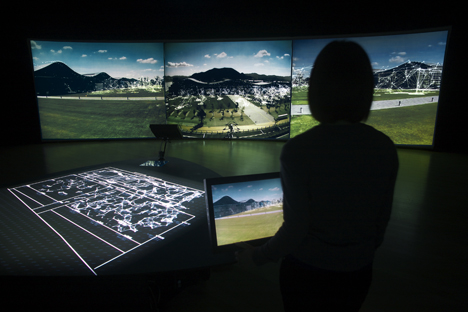
    an augmented reality architectural form, driven by real time environmental information such as temperature, brightness, humidity, wind direction and sound. nodes reflecting the sensor network are the seeds for the virtual architecture, growing and subsiding like an organism.

    [link: corpora.ycam.jp & doublenegatives.jp |thnkx thedlab]
    see also: stranger than fiction infographics, statistical wall numbers & rixome.

    corpora_components.jpg

    corpora_pano.jpg

    http://www.shift.jp.org/en/archives/2007/11/corpora_in_sighte.html

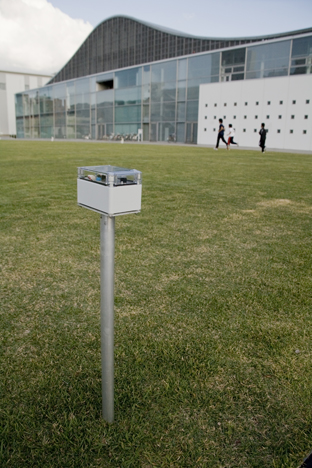
    Corpora in Si(gh)te means “integration of view”. This work is being exhibited at the Yamaguchi Center for Arts and Media (YCAM). For the exhibit, they placed 40 sensors in Chuou Park located next to the center. Each sensor senses information regarding its surrounding environment, such as temperature, light, wind, sound, and the movement of people. The program processes the information in 3-D. This results in a constantly changing shape and structure, depending on the complexity of the rules for that specific piece. For example, it stretches up when it's dark; makes a void when people are around; adjusts to the forces and direction of the wind.

    Corpora in Si(gh)te (YCAM)

    The changing information of the environment, collected by the sensors, will be sent to Corpora in order to produce a new node which then constructs Corpora. So, a piece of architecture is constructed based on the aggregate of the various nodes. It might be easier to understand if you imagine an ant's nest or corals. Points and lines that change every minute depending on the environment will be collected and will ultimately create one virtual building. It is very digital indeed, but also an organic and plant-like form of architecture.

    Corpora in Si(gh)te (YCAM)
    ©
    http://doublenegatives.jp/
    frame: 2005 Daejeon FAST : Future of Art, Science and Technology
    location: Daejeob Museum of Art in Daejeon Korea

    Related Articles


    $26.39