YCAM invites media artists from Japan and abroad to produce new pieces of art, and presents these commissioned works at its exhibition facilities. Within the realm of interdisciplinary creative work encompassing art, science and information technology, we put emphasis not only on visual art, but on sound and software art as well. YCAM's "InterLab" department generally co-produces works together with artists, and assists them with program development, research, and the design of hardware and interfaces. The results are then applied and further developed in YCAM's educational programs.

Ryoji Ikeda presents new and existing works from his datamatics series.
The datamatics series is a long-term programme of moving image, sculptural, sound and new media works that take data as their theme and material, exploring the ways in which abstracted views of reality - data - are used to encode, understand and control the world.
Ikeda's works both examine and apply mathematical and scientific theory, and test the extreme potentials of digital technology, to reveal the microscopic matter - and data - that permeates our universe, whilst challenging our own thresholds of perception.
This solo exhibition presents the recent works data.film [nº1-a] and data.tron, alongside a major new installation commissioned by YCAM, entitled test pattern [nº1]. The exhibition opens with a live performance of Ikeda's critically acclaimed concert piece datamatics [ver.2.0].
http://archive.ycam.jp/#

 gravicells
Official WEB SITE


Representation about the gravity used as a background
Text by Seiko Mikami + Sota Ichikawa
In the center of the installation space is a 6m x 6m floor with a built-in sensor. The moment a participant stands and moves on it, the variation of his or her position, weight, and speed is automatically and continuously measured, analyzed, and reflected on light, sound, and image, generating substantial spatial changes. Overlapping the real space, this simultaneous imaginary space reconstructs the spatial geometry, and distorts the coordinates through the participant's weight and position.
On the floor screen is projected a grid image to measure density. It constitutes the geometry that generates and modifies in real time the coordinates linked to the participant's position and movements. In addition, the body index is represented by both the multi-channel sound degree and a level line created by LED light, and set on one's eye level. Through this continuous data in the light change and sound direction, the space changes.
The place of the installation is simultaneously surveyed by GPS satellites, so it has the observatory point outside the earth. It expands our area of perception, and reveals that the installation site itself is no longer static but always moving by gravity in relativity. The installation provides us with a device to sense the possibility of the dissolution of gravity, which has multiple meanings.
http://www.jaist.ac.jp/ks/labs/nagai/prof/nagai/index-e.html
http://www.jaist.ac.jp/is/index.php
Japan Advanced Institute of Science and Technology
YUKARI Nagai
What is the creativity in design?
The research goes on with the Process of Design's Creative Thinking. The way of this research adopts the method of experimental observation as core in cognitive science, semiotics as axis in visual language analysis.
The research field also connects with others: the visual creativity activities of Communication Design, Architecture Design, Visual Art, Modern Art, Cartoon, and others, Conceptual Art, Molding expression and education, learner's support.
If you get interested in study with the fields of design, art, architecture, visual / dynamic / sense expression and other undeveloped human's creativity, please make a visit to this laboratory at once by all means.
We make a study of how they are produced.
It is considered that study is also one form in which human's creativity is expressed.
http://www.jaist.ac.jp/ks/labs/nagai/english/index.html
Mechanism of Decision Making
Research Field
The research is on the Process of Creative Thinking in Design, Design Semantics, Theory of Design Expression, and Visual Communication Design.
Laboratory's IntroductionNAGAI Laboratory is the purpose of research with creative process in design and various kinds of fields. The study of personal creativity in society, the method of design in circulative society, the work of art's creative process, creative engineering, polysemy of architecture , the creativity in literature, creative education, scientific and mathematical education …the subject of everyone's study is manifold. However, as possible to catch really in the process of creativity is the common posture. It is necessary to discuss repeatedly because the field of methodology in creative research has not established yet. While the opinion disputes gradually, each member aims at the advanced result and goes forward in his/her field.
Contact address: YUKARI Nagai
Address : 1-1, Asahidai, Tatsunokuchi, Nomi,Ishikawa, Japan 923-1292
Japan Advanced Institute of Science and Technology
School of Knowledge Science Mechanism of Decision Marking
Nagai Lab.
Tel: 0761-51-1706
http://www.ntticc.or.jp/Exhibition/2007/SilentDialogue/index.html
 Nature and the environment that surrounds us are in constant change. To turn our attention to the behavior of other living things as the environment changes is to realize the effects on ourselves, living in that same environment, and that we are all linked in a single ecosystem. In other words, we are constantly receiving messages from the very environment we inhabit.
Plants and animals form closed systems that interact with the natural environment to acquire information and maintain the equilibrium of their internal environments through homeostasis. By examining the natural environment from the point of view of the plants and animals that inhabit it, we can pinpoint the environmental data they gather with the various sensors they possess. The world seen in this way may be totally different from the one we human beings perceive. By investigating how plants, animals, or insects communicate with each other, by exploring their ecologies and their behavior towards each other, we discover new perspectives on how human beings can relate to them as well.
This exhibition, then, focuses on this "invisible communication." The works presented explore our relationships with the natural environment through making it visible or audible, based on biological information, thanks to uses of biosensors. The exhibition also uses computer simulations of the natural environment in an effort to explore new conceptions of the environment these technologies reveal.
Artists/Works:
FUJIHATA Masaki + DOGANE Yuji - “Botanical Ambulation Training”;
by Japanese media artists Masaki Fujihata and Yuji Dogane, which moves plants in three dimensions, monitoring their conditions through microsensors.
Orchisoid 03, 2003, by FUJIHATA Masaki + DOGANE Yuji
In Orchisoid 03, Dogane Yuji worked with renowned digital media artist Fujihata Masaki (some of his previous works include Unreflective Mirror and Beyond Pages) to better understand adaptation and homeostasis in plants. For this project, several orchids were again wired and set to experience a variety of vibrations from the shifting table they rest upon. The artists concluded that the physiology of the plants changed the same way as human brain wave patterns change in response to stress. And because the orchid’s wave-activity fluctuates in real time, rather quickly, Dogane recognized it as a sign of high-level information processing.
FUJIEDA Mamoru + DOGANE Yuji - “Paphio in My Life”; Dogane Yuji, a botanist who has focused his research on orchids, collaborated with composer Fujieda Mamoru for Paphio in My Life, where the inaudible sounds of plants are picked up by connected wires then converted to manifest a plant’s ‘voice.’ As plants respond to environmental stress, simulated by varying vibrations induced by the artists’ algorithmic program, the plant’s ‘voices’ vary accordingly. By broadcasting such a dialog, Dogane hopes to bring us closer to plants through this glimpse into their life.
Christa SOMMERER & Laurent MIGNONNEAU - “Interactive Plant Growing”; Also on display were Christa Sommerer and Laurent Mignonneau's installation Interactive Plant Growing from 1992. Touch the plants and watch the screen fill up with a digital cascade of the plant’s leaves; still a great example of physical action into digital realization.
Lois & Franziska WEINBERGER - “Home Voodoo I”, “Home Voodoo II”, “Datura stramonium”, Documentary film “Das Leben will leben: Die Kunst der Weinberger”;
Michael PRIME - “Ha, Ha! Your Mushrooms Have Gone”; by British sound ecologist Michael Prime, which shows the bioelectricity of shiitake mushrooms in the form of sounds that change as the viewers move around the gallery;
For a glance into the secret lives of mushrooms, Michael Prime affixed bio-sensors to various kinds of locally grown mushrooms to reveal a dialog we perhaps thought never even existed. From their docile setting in an aquarium, the bio-receptors broadcast the sounds of pulsating waves of noise through speakers in the installation space. The result- a surprising continuous drone that shifted tones rather sporadically revealing a brash, trance-like state of mushrooms- fascinating, surreal and surprising.
ANDO Takahiro - “Bio Photon : Allelopathy”;
One of the most interactive works displayed was Bio Photon: Allelopathy by Ando Takahiro. As plants germinate and grow, photons are emitted from their leaves. They are invisible to our eyes but in his work Ando work visualizes the amount of photons via the discreet sensors which results in a hyper-sporadic display of flickering lights across the dome at light speed, if you will. Ando has intentionally set up two electric-current-generating for us, which upon touching, allow us to feel the currents that we couldn’t otherwise visualize.
tEnt (TANAKA Hiroya + CUHARA Macoto); “Call ⇔ Response”; Listening room.
Open Space
Open Space 2007(Parmanent Exhibition)| >Details |
Organizer : NTT InterCommunication Center[ICC]
ICC aims to create an environment where one encounters and engages with the progressive experimental activities derived from the dialogue between technology and art.
http://www.ntticc.or.jp/Exhibition/2007/Openspace2007/art_technology/index.html
Art & Technology Zone
Art & Technology Zone is an exhibition area where one can investigate the dialogue between technology and art. It presents an overview of artistic expression within information society and its context while also surveying changes of artistic style, era and social order.
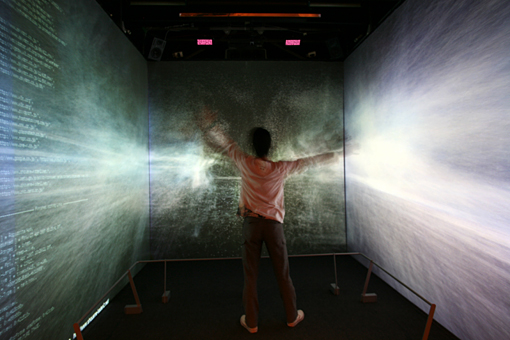
HIRAKAWA Norimichi
http://www.ntticc.or.jp/Exhibition/2007/Openspace2007/art_technology/driftnet.html
These abstract waves are generated by downloading content data, which is supposed to be viewed on browsers in the intangible and virtual space of the Internet, as a sequence of numerical data. This work accesses the Internet without the interfaces we usually need to see websites, such as a mouse, keyboard, and browser. The term "net surf," which refers to the act of visiting and viewing websites, is a physical metaphor that reminds us of actual space. In this work, we literally move our body to access to the information space of the Internet and, as the title suggests, drift through the Internet.

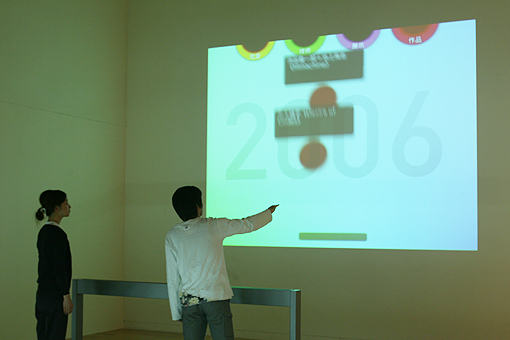
Tsunamii.net
www.tsunamii.net
Tien Wei Woon (*1975 Singapore) and Charles Lim Yi Young (*1973 Singapore) and
Scientist, Melvin Phua (*1975).
Since then the theme of internet and geography has been prominent in their series of work, alpha series.
www.soiizen.com
consists of: Yu-Chuan Tseng, Chia-Hsiang Lee

Information ME create digital portraits of being nowadays. In the process of representation, participant’s face will be replaced and reconstructed by information of SMS and on-line news in real time.

Flow, 2006
When the internet becomes our resource of information, we try to fetch the news as many as possible from the net. The work ‘Flow’ is an interactive art work creating a context of flowing information which is unable to be hold and instead of intermix.

ACM Multimedia 2006 Conference, Interactive Art Program,short paper, 2006.10.23-10.25
 Let's Make ART, 2003
"Let's Make Art" is an attempt to create art in real time by inviting interaction with different artists through the internet and in this way to reconsider the meaning of art in the technological age.


No comments:
Post a Comment