http://corpora.ycam.jp/en/online.html
Corpora in Si(gh)te
Virtual architecture grows in accord with the environment.

 http://corpora.ycam.jp/en/online_071201_01.html
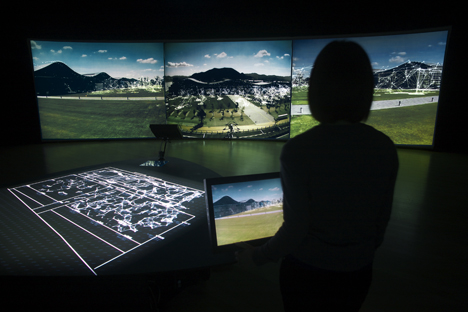
1. map of environment data from mesh network in YCAM & the central park
 http://corpora.ycam.jp/en/online_080101_02.html
2. analytic image of sky above YCAM


 http://doublenegatives.jp/
time: April 29(fri) -- July 3(sun) 2005
group exhibition "Open Nature"
location: NTT Inter Comunication Center Tokyo
autonomous architecture
16 January 2008

Organizer: Yamaguchi City Foundation for Cultural Promotion
Support: Embassy of Switzerland, Embassy of the Republic of Hungary in Tokyo, Yamaguchi City, The Board of Education of Yamaguchi City
Special Cooperation: University of the Arts Zurich (ZHdK), Department Interaction Design, Zurich Switzerland, Nextlab, Budapest Hungary
Cooperation: The Asahi Shimbun
Produced by: Yamaguchi Center for Arts and Media (YCAM)
Co-production: YCAM InterLab
Project Curator: Kazunao Abe (YCAM)
an augmented reality architectural form, driven by real time environmental information such as temperature, brightness, humidity, wind direction and sound. nodes reflecting the sensor network are the seeds for the virtual architecture, growing and subsiding like an organism.
[link: corpora.ycam.jp & doublenegatives.jp |thnkx thedlab]
see also: stranger than fiction infographics, statistical wall numbers & rixome.


Corpora in Si(gh)te means “integration of view”. This work is being exhibited at the Yamaguchi Center for Arts and Media (YCAM). For the exhibit, they placed 40 sensors in Chuou Park located next to the center. Each sensor senses information regarding its surrounding environment, such as temperature, light, wind, sound, and the movement of people. The program processes the information in 3-D. This results in a constantly changing shape and structure, depending on the complexity of the rules for that specific piece. For example, it stretches up when it's dark; makes a void when people are around; adjusts to the forces and direction of the wind.
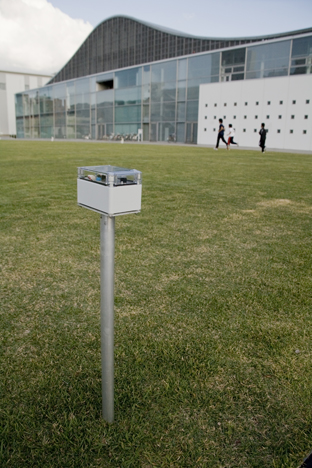
The changing information of the environment, collected by the sensors, will be sent to Corpora in order to produce a new node which then constructs Corpora. So, a piece of architecture is constructed based on the aggregate of the various nodes. It might be easier to understand if you imagine an ant's nest or corals. Points and lines that change every minute depending on the environment will be collected and will ultimately create one virtual building. It is very digital indeed, but also an organic and plant-like form of architecture.
©
 frame: 2005 Daejeon FAST : Future of Art, Science and Technology
location: Daejeob Museum of Art in Daejeon Korea
Related Articles


No comments:
Post a Comment