From Technological to Virtual ArtFrank Popper
Published: Cambridge MA ; January 2007
ISBN-10: 0-262-16230-X ISBN-13: 978-0-262-16230-2
REVIEW:http://mitpress.mit.edu/catalog/item/default.asp?ttype=2&tid=10448
In From Technological to Virtual Art, respected historian of art and technology Frank Popper traces the development of immersive, interactive new media art from its historical antecedents through today's digital, multimedia, and networked art. Popper shows that contemporary virtual art is a further refinement of the technological art of the late twentieth century and also a departure from it. What is new about this new media art, he argues, is its humanization of technology, its emphasis on interactivity, its philosophical investigation of the real and the virtual, and its multisensory nature. He argues further that what distinguishes the artists who practice virtual art from traditional artists is their combined commitment to aesthetics and technology. Their "extra-artistic" goals -- linked to their aesthetic intentions -- concern not only science and society but also basic human needs and drives.
Defining virtual art broadly as art that allows us, through an interface with technology, to immerse ourselves in the image and interact with it, Popper identifies an aesthetic-technological logic of creation that allows artistic expression through integration with technology. After describing artistic forerunners of virtual art from 1918 to 1983 -- including art that used light, movement, and electronics -- Popper looks at contemporary new media forms and artists. He surveys works that are digital based but materialized, multimedia offline works, interactive digital installations, and multimedia online works (net art) by many artists, among them John Maeda, Jenny Holzer, Brenda Laurel, Agnes Hegedus, Stelarc, and Igor Stromajer. The biographical details included reinforce Popper's idea that technology is humanized by art. Virtual art, he argues, offers a new model for thinking about humanist values in a technological age.
About the Author
Frank Popper is Professor Emeritus of Aesthetics and the Science of Art at the University of Paris VIII. He is the author of Origins and Development of Kinetic Art, Art, Action, and Participation, Art of the Electronic Age, and other influential works on art and technology.
The Hidden Sense : Synesthesia in Art and Science
http://mitpress.mit.edu/catalog/item/default.asp?ttype=2&tid=11303Cretien van Campen
October 2007
ISBN-10: 0-262-22081-4 ISBN-13: 978-0-262-22081-1
 - Published: Cambridge MA '07
Explores the phenomenon of synesthesia - in which two or more senses cooperate in the perception of an experience normally confined to one sense, such as hearing music in colours or tasting voices - from both artistic and scientific perspectives, looking at examples of synesthesia in visual art, music and literature, and in recent neurological research. The author concludes that it is not a literary technique, an artistic trend or a metaphor, but perhaps a hidden sense - a way to think visually
 Table of Contents and Sample ChaptersWhat does it mean to hear music in colors, to taste voices, to see each letter of the alphabet as a different color? These uncommon sensory experiences are examples of synesthesia, when two or more senses cooperate in perception. Once dismissed as imagination or delusion, metaphor or drug-induced hallucination, the experience of synesthesia has now been documented by scans of synesthetes' brains that show "crosstalk" between areas of the brain that do not normally communicate. In The Hidden Sense, Cretien van Campen explores synesthesia from both artistic and scientific perspectives, looking at accounts of individual experiences, examples of synesthesia in visual art, music, and literature, and recent neurological research.
Van Campen reports that some studies define synesthesia as a brain impairment, a short circuit between two different areas. But synesthetes cannot imagine perceiving in any other way; many claim that synesthesia helps them in daily life. Van Campen investigates just what the function of synesthesia might be and what it might tell us about our own sensory perceptions. He examines the experiences of individual synesthetes--from Patrick, who sees music as images and finds the most beautiful ones spring from the music of Prince, to the schoolgirl Sylvia, who is surprised to learn that not everyone sees the alphabet in colors as she does. And he finds suggestions of synesthesia in the work of Scriabin, Van Gogh, Kandinsky, Nabokov, Poe, and Baudelaire.
What is synesthesia? It is not, van Campen concludes, an audiovisual performance, a literary technique, an artistic trend, or a metaphor. It is, perhaps, our hidden sense--a way to think visually; a key to our own sensitivity.
About the Author
Cretien van Campen is a social scientist at the Social and Cultural Planning Office of the Netherlands. He is the author of two books on perception and visual art.

| Stelarc: The Monograph : Marquard Smith (ed)
| ISBN-10: 0-262-69360-7
ISBN-13:978-0-262-69360-8 | Published: Cambridge MA '05 | | An overview of this performance and media artist's work, with its diverse resources and references, including virtual reality, robotics, prosthetics, the Internet and biotechnology. http://mitpress.mit.edu/catalog/item/default.asp?ttype=2&tid=11326
4 Stelarc's Technological "Transcendence"/Stelarc's Wet Body: The Insistent Return of the Flesh
Amelia Jones 87
5 The Evolutionary Alchemy of Reason
Brian Massumi 125
6 A Sensorial Act of Replication
Julie Clarke 193
7 Animating Bodies, Mobilizing Technologies: Stelarc in Conversation
Stelarc and Marquard Smith
...an invaluable and welcome resource for everyone engaged with discourses and disciplines spanning visual, performance and digital art, cyberculture, artificial intelligence, biotechnology and robotics."
|
|
|
|
|
|
Victoria University of Wellington
Title: Proceedings [electronic resource] / Symposium on Haptic Interfaces for Virtual Environment and Teleoperator Systems.
Publisher: PLos Alamitos, CA : IEEE Computer Society
Full text available from IEEE Electronic Library Online: 2006 to 2006
http://www.hapticssymposium.org/next_conference.htm
Haptics Related Links
Haptics Research Labs
Publication ArchivesDe Meredieu, Florence: Digital and Video Art Published: Chambers (United Kingdom) Edinburgh '05
A lively, well-informed introduction to the exciting and innovative art forms made possible by the emergence of digital and video technology in the mid-20th century. It examines a wide range of current material including multi-media installations, virtual worlds, interactivity and artists' websites.
ISBN: 9780550101709
ISBN-10: 0550101705
Chapter: Interactive environments and Virtual Worlds
Edmond Couchot, Michel Brett and Marie-Helene Tramus,
http://sharonferris.wordpress.com/2007/11/28/florence-de-meredieu-2005-digital-and-video-art-1st-ed-edinburgh-chambers/ The Feather, (1988-92) and I sow to the Four Winds (1990)
A reaction provoked installation. Where the artists creates a virtual environment where the participant interacts with it in real time. The visitors use breath to interact with installations, which in this example is a simplistic dandelion and the visitors breath ”gradually scatters its seeds”
“It plunges the creator, the artist, but also the viewer, into an intermediate zone at the interface between the real and the virtual” (cited in Digital and Video Art. 2005 p15 8)
I have used this example as I feel that it is trying to conceptualise the model in which I intend to explore when creating my project. Using breath to interact with objects that we associate actively using our breath to do, thus conducting a proven formula to invoke the intaractor rhetoric relationship with the object, which in this case is a dandelion.
Preview this book
The State of the Real: Aesthetics in the Digital AgeBy Damian Sutton, Susan Brind, Ray McKenzie, Ray (Raymond) McKenzie
Published 2007
I.B.TaurisISBN:1845110773
The notion of "the real" continues to be hotly debated in an era when the internet, virtual reality, cybertheory and bioethics challenge the very nature of "reality". Combining the advantages of a critical reader with the immediacy of cutting-edge debate, practitioners and commentators provide crucial insights into contemporary aesthetics, engaging with the ideas of critics and thinkers from Linda Nochlin through to Lyotard and Baudrillard.
| Title: | Cyberspace/cyberbodies/cyberpunk : cultures of technological embodiment / edited by Mike Featherstone and Roger Burrows. |
|---|
| Publisher: | London : Sage, 1995.
| ISBN: | 0761950850 (pbk.) |
|---|
| 0761950842 |
How can we interpret cyberspace? What is the place of the embodied human agent in the virtual world?This innovative collection examines the emerging arena of cyberspace and the challenges it presents for the social and cultural forms of the human body. It shows how changing relations between body and technology offer new arenas for cultural representations. At the same time, the contributors examine the realities of human embodiment and the limits of virtual worlds. Topics examined include: technological body modifications, replacements and prosthetics; bodies in cyberspace, virtual environments and cyborg culture; cultural representations of technological embodiment in visual and literary productions; and cyberpunk science fiction as a pre-figurative social and cultural theory.Cyberspace/Cyberbodies/ Cyberpunk was simultaneously published as Volume 1 Issue 3/4 of Body & Society.
|
| | The virtual embodied : presence/practice/technology /
edited by John Wood.
|
|---|
Publisher:
| London ; New York : Routledge, 1998.
| 041516026X |
|---|
| 0415160251 (hardbound : alk. paper) |
| 0415140056 (pbk. : alk. paper)
Call Number: B29 V819
Key words and phrases virtual reality, Goldsmiths College, Spinoza, Buddhism, Gustav Metzger, Descartes, Gilles Deleuze, dualistic, Peter Cresswell, absolutely infinite, University of London, consumerism, body without organs, postmodern, Spinozist, Hegel, However, Sharon Lopatka, Thousand Plateaus, self-harm
|
|
| Title: | Hyperbodies : towards an E-motive architecture / Kas Oosterhuis. |
|---|
| Main Author: | Oosterhuis, Kas.
| ISBN: | 3764367369 |
|---|
| 3764369698(pbk.) : L.8.00
Call Number: NA2728 O59 H
Key words and phrases scale-free network, complex adaptive system, unibodies, 3d model, idiot savant, Variomatic, Virtools, information architect, hive mind, direct democracy, swarm intelligence, flocking behavior, boids, Ray Kurzweil, Autolisp, Graphisoft, genetic code, numpads, building body, Intelligent building
.. unibodies. E-motive styling gives style to data-driven constructs. Information theory hypothesizes that matter and ideas are disguises of informative ...
Hyperbody: is a data-driven construct changing in real time and connected to environments changing in real time.
Hyperarchitecture: links thru networks to other connected environments
|
|
| Title: | Seduced & abandoned [videorecording] : the body in the virtual world. |
|---|
| Publisher: | London : ICA Video, [199-]
Description: 4 videocassettes (190 min.) VHS PAL
series of lectures about cyberspace and virtual reality in terms of gender and art.
Call Number: Vis 2100
|
|
|  Preview this book
| | Virtual theatres : an introduction / . |
Giannachi, Gabriella.
ISBN:0415283795
Welcome to theatre of the 21st century, in which everything -except for the viewer can be simulated. "Virtual Theatres" is the first full-length book of its kind to offer an investigation of the interface between theatre performance and digital arts. Through discussion of a variety of artists and performers - including Stelarc, Orlan, Forced Entertainment, Merce Cunningham and Blast Theory - Gabriella Giannachi analyses the aesthetic concerns of current computer arts practices and shows how they radically question our conventional uses and definitions of time, space, place, character, identity and realness. The book not only allows for a re-interpretation of what is possible in the world of performance practice but also demonstrates how 'virtuality' has come to represent a major parameter for our understanding and experience of contemporary art and life.
|
|
|---|
Title: Performance and technology : practices of virtual embodiment and interactivity /edited by Susan Broadhurst and Josephine Machon.
Publisher: New York : Palgrave Macmillan, 2006.
body, space, and technology / Susan Broadhurst and Josephine Machon -- 1. Bodies without bodies / Susan Melrose -- 2. Truth-seeker’s allowance : digitising Artaud / Steve Dixon -- 3. Transformed landscapes : the choreographic displacement of location and locomotion in film / John Cook --ISBN: 1403999074 (cloth)Call Number: NX180 T4 P438
The following paper attempts to examine the problem of using metaphor and analogy when discussing digital performance and theory. A succinct but cogent multi-disciplinary history of the reduction of language tropes to digital syntax is presented with direct commentary on the invention of scientific method and subsequent work in linguistics, cognitive engineering, and psycho-analysis. It is suggested that digital telecommunications are partially responsible for the techno-cultural trend towards novel forms of psychopathology, specifically so-called 'social autism'. It is argued that this trend can be partially assuaged and ameliorated because of the implications of new discoveries regarding synaesthesia and 'mirror neurons'. An illustration of the practicality of this approach is provided concerning the 'Emergent Dress' project in digital performance.Massey libraryElectronic Mediations Series:Title
Digital sensations : space, identity, and embodiment in virtual reality /
Author Hillis, Ken
Published Minneaplis : University of Minnesota Press, c1999
Subject Heading Human-computer interaction
Considers the cultural and philosophical assumptions underlying virtual reality, and how the technology affects the real world.
Virtual reality is in the news and in the movies, on TV and in the air. Why is the technology—or the idea—so prevalent precisely now? What does it mean—what does it do—to us? Digital Sensations looks closely at the ways representational forms generated by communication technologies—especially digital/optical virtual technologies—affect the "lived" world.
Virtual reality, or VR, is a technological reproduction of the process of perceiving the real; yet that process is "filtered" through the social realities and embedded cultural assumptions about human bodies, perception, and space held by the technology's creators.
Through critical histories of the technology—of vision, light, space, and embodiment—Ken Hillis traces the various and often contradictory intellectual and metaphysical impulses behind the Western transcendental wish to achieve an ever more perfect copy of the real. Because virtual technologies are new, these histories also address the often unintended and underconsidered consequences--such as alienating new forms of surveillance and commodification--flowing from their rapid dissemination. Current and proposed virtual technologies reflect a Western desire to escape the body, Hillis says.
Exploring topics from VR and other, earlier visual technologies, Hillis's penetrating perspective on the cultural power of place and space broadens our view of the interplay between social relations and technology.
"His discussion is ambitious; not only does he bring together multiple disciplines and philosophies, he traces history from the Renaissance to the present." —Technical Communication Quarterly
"Ken Hillis has written a wise interrogation of the impact of virtual environments and the marriage of new digital and visual technologies. Carefully balancing between the dangers of all-too-common and too-easy skepticism and the risk of being seduced by the new medium, this book analyses the manner in which the use of technologies to produce virtual environments (VEs) changes the bases on which assumptions concerning democratic politics and identity flourish." —Space and Culture
“Digital Sensations supplies an indispensable critique of mainstream VR practices, problematizing the simple assurances that have become a staple of virtual technology and cyberculture. In charting this particular course, Hillis’s analysis is simply revolutionary. That is, his critique takes aim at, works within, and overturns the terms of traditional metaphysical oppositions. Its analysis and critique of the ideology of VR is attentive and perspicacious. Hillis deploys nothing short of a revolutionary analysis that turns the tables on contemporary VR research. In doing so, he provides the critical apparatus by which to confront and challenge the seductive rhetoric of incorporeal interaction that has become commonplace in cyberculture.” —Dale Bertelsen, Critical Studies in Media Communication
Ken Hillis is assistant professor in the Department of Communication Studies and adjunct professor of geography at the University of North Carolina at Chapel Hill.
from the series:
Electronic Mediations Series
Series editors:
Mark Poster, University of California, Irvine
Samuel Weber, Northwestern University
Katherine Hayles, UCLA
Electronically mediated communication—ranging from the Internet and virtual reality technologies to digitized art and literary hypertexts—is sparking significant changes in society and culture, politics and economics, thinking and being. The books in this series explore the humanistic and social implications of these new technologies.
http://www.upress.umn.edu/byseries/electronic.html
Books in the series:
Victoria Vesna, editor
Database Aesthetics
Art in the Age of Information Overflow
volume 20 | 2007
Discovering the role of data in creating a new way of experiencing—and making—art.
Database Aesthetics examines the database as cultural and aesthetic form, explaining how artists have participated in network culture by creating data art. The essays in this collection look at how an aesthetic emerges when artists use the vast amounts of available information as their medium. Here, the ways information is ordered and organized become artistic choices, and artists have an essential role in influencing and critiquing the digitization of daily life.
Contributors: Sharon Daniel, Steve Deitz, Lynn Hershman Leeson, George Legrady, Eduardo Kac, Norman Klein, John Klima, Lev Manovich, Robert F. Nideffer, Nancy Paterson, Christiane Paul, Marko Peljhan, Warren Sack, Bill Seaman, Grahame Weinbren.
Don Ihde
Bodies in Technology
volume 5 | 2002
ISBN: 0-8166-3846-2
ISBN-13: 978-0-8166-3846-8
$60.00 cloth
ISBN: 0-8166-3845-4
ISBN-13: 978-0-8166-3845-1
An original exploration of the ways cyberspace affects human experience.New technologies suggest new ideas about embodiment: our "reach" extends to global sites through the Internet; we enter cyberspace through the engines of virtual reality. In this book, a leading philosopher of technology explores the meaning of bodies in technology—how the sense of our bodies and of our orientation in the world is affected by the various information technologies. Bodies in Technology begins with an analysis of embodiment in cyberspace, then moves on to consider ways in which social theorists have interpreted or overlooked these conditions. An astute and sensible judge of these theories, Don Ihde is a uniquely provocative and helpful guide through contemporary thinking about technology and embodiment, drawing on sources and examples as various as video games, popular films, the workings of e-mail, and virtual reality techniques.
Charting the historical, philosophical, and practical territory between virtual reality and real life, this work is an important contribution to the national conversation on the impact technology—and information technology in particular—has on our lives in a wired, global age.
“This book by Ihde explores the meaning of bodies in technology, that is, how the sense of our bodies and of our orientation in the world are affected by information technologies. The book is certainly a contribution to the worldwide conversation and debates on the impact of technology and especially information technology on the lives of human beings in a global age, especially regarding contemporary thinking about technology and embodiment.” —Mousaion
Don Ihde is distinguished professor in the Department of Philosophy, and is also affiliated with the history of science and women's studies programs, at SUNY, Stony Brook.
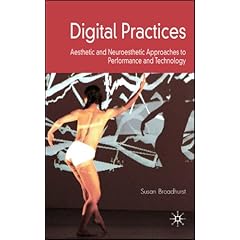
See larger image
Digital Practices: Aesthetic and Neuroesthetic Approaches to Performance and Technology
by Susan Broadhurst (Author)
Palgrave Macmillan
Published: September 2007
ISBN: 978-0-230-55313-2 ISBN-10: 0-230-55313-3
Digital Practices offers a description of a range of art and performance practices that have emerged within the context of a broad-based technological infiltration of all areas of human experience. They are integral to alternative and also to mainstream performance and culture, and demand perceptive strategies that can address the interface between the physical and the virtual. In this pioneering study, Susan Broadhurst explores the aesthetic theorisation of these practices and extends her analysis to include other approaches, including those offered by recent research into neuroesthetics.
Note: The following text was. part. of keynote. talk. at Second Cognitive Technology ...(PDF link)
The Cyborg's Dilemma: Embodiment In Virtual Environments ...
(PDF) Dr. Frank Biocca Ameritech Professor of Telecommunication Media Interface & Network Design (M.I.N.D.) Lab Michigan State University
Abstract
Thls paper poses the question: How does the representation of the body in virtual environments affect the mind? This article considers how virtual reality interfaces are evolving to progressively embody the user. The effect of embodiment on the sensation of physical presence, social presence, and self presence in virtual environments is discussed. The effect of avatar representation on body image and body schema distortion is also considered.
Interaction,. virtual reality, embodiment, presence, cyborgs.

Preview this book
Virtual Art : From Illusion to Immersion
Oliver Grau
ISBN-10: 0-262-57223-0 ISBN-13: 978-0-262-57223-1
October 2004
Although many people view virtual reality as a totally new phenomenon, it has its foundations in an unrecognized history of immersive images. Indeed, the search for illusionary visual space can be traced back to antiquity. In this book, Oliver Grau shows how virtual art fits into the art history of illusion and immersion. He describes the metamorphosis of the concepts of art and the image and relates those concepts to interactive art, interface design, agents, telepresence, and image evolution. Grau retells art history as media history, helping us to understand the phenomenon of virtual reality beyond the hype.Grau shows how each epoch used the technical means available to produce maximum illusion. He discusses frescoes such as those in the Villa dei Misteri in Pompeii and the gardens of the Villa Livia near Primaporta, Renaissance and Baroque illusion spaces, and panoramas, which were the most developed form of illusion achieved through traditional methods of painting and the mass image medium before film. Through a detailed analysis of perhaps the most important German panorama, Anton von Werner's 1883 The Battle of Sedan, Grau shows how immersion produced emotional responses. He traces immersive cinema through Cinerama, Sensorama, Expanded Cinema, 3-D, Omnimax and IMAX, and the head mounted display with its military origins. He also examines those characteristics of virtual reality that distinguish it from earlier forms of illusionary art. His analysis draws on the work of contemporary artists and groups ART+COM, Maurice Benayoun, Charlotte Davies, Monika Fleischmann, Ken Goldberg, Agnes Hegedues, Eduardo Kac, Knowbotic Research, Laurent Mignonneau, Michael Naimark, Simon Penny, Daniela Plewe, Paul Sermon, Jeffrey Shaw, Karl Sims, Christa Sommerer, and Wolfgang Strauss. Grau offers not just a history of illusionary space but also a theoretical framework for analyzing its phenomenologies, functions, and strategies throughout history and into the future.
Telematic Connections: The Virtual Embrace
http://telematic.walkerart.org/overview/index.html
Telematic Connections, like many of the works in it, is a hybrid affair. Part history, part speculation, partly onsite, partly online, it crosses boundaries between art, communications, and popular culture. Its four sections include installation works, past and recent film clips, online projects, and a "telematics timeline." Through these various media, the exhibition presents the ways in which artists use technology—and the Internet—to explore both the utopian desire for an expanded, global consciousness and the dystopian consequences of our collective embrace, willing or not, of computer-mediated human communications. At the same time Telematic Connections places this emergent work within a historical framework.
Sensory Research: Multimodal Perspectives
Book by Ronald T. Verrillo, Jozef J. Zwislocki; Lawrence Erlbaum Associates, 1993
Subjects: Senses and sensation
Multimodal Perspectives Edited by Ronald T. Verrillo Institute for Sensory Research, Syracuse University LAWRENCE ERLBAUM ASSOCIATES...
His contributions to the knowledge of the hydromechanical, neurophysiological, and perceptual mechanisms of the auditory system are truly monumental. In addition, his contributions to the comprehension of the mammalian auditory system include not only landmark ideas, but also many of the experimental findings in psychoacoustics and peripheral auditory physiology that constitute the database which has provided a springboard for research in laboratories throughout the world. His efforts to link physics, biology, and psychophysics to create a basis for our understanding of the nervous system have had an influence that extends far beyond the science of acoustics.
Although the purpose of this conference was to recognize the many achievements of Professor Zwislocki, the spirit of the participants was to honor him in a manner that best characterized his lifetime dedication to research, that is, to report the results of their own work. Consequently, this volume is first and foremost a compilation of scientific papers in the area of sensory research. Some are reports of recent experiments and some present an overview of research efforts extending from the past up to ongoing work. His influence can be recognized in all of the contributions and some explicitly describe the ties between their own work and the germinal ideas planted by him. This volume, in reflecting the rapid progress being made in sensory science and written by those who are making it, is a fitting tribute to Zwislocki, who always stood at the forefront of his science.

Philosophy and the Adventure of the Virtual: Bergson and the Time of Life
Book by Keith Ansell Pearson; Routledge, 2002
Subjects: Bergson, Henri--1859-1941, Time
ISBN:0415237289
Informed by the philosophy of the virtual, Keith Ansell Pearson offers up one of the most lucid and original works on the central philosophical questions. He asks that if our basic concepts on what it means to be human are wrong then, what is this to mean for our ideas of time, being, consciousness? A critical examination ensues, one informed by a multitude of responses to a large number of philosophers. Under discussion is the mathematical limits as found in Russell, questions on Relativity, Kant's notion of judgement, Popper, Dennett, Dawkins and Proust. He brings into the rapport the concepts of Bergson and their explosive insights into the idea of time.
| 9 |
Bergson, Deleuze, plane of immanence |
| 43 |
Parmenides, theory of Relativity, Popper |
| 70 |
creative evolution, convergent evolution, natural selection |
| 97 |
Plotinus, negative theology, self-differentiation |
| 115 |
Kant, teleology, hylozoism |
| 140 |
plane of immanence, representational terms, phenomenology |
more » | 167 |
eternal return, Combray, Nietzsche |

Hyperreality: Paradigm for the Third Millenium
Book by John Tiffin, Nobuyoshi Terashima; Routledge, 2001
Subjects: Computers--Social Aspects, Reality, Virtual Reality
ISBN:0415261031
What comes after the Internet? The world of the virtual, a place where you could be hard pressed to know if the person standing next to you is physically real or virtual or whether they have human or artificial intelligence. The Third Millennium promises to bridge the gap between the natural and artificial in new and powerful ways- namely HyperReality. Here there are new scopes for telemedicine, HyperTranslation (to speak in one language and be heard in another), and virtual reality popping out of books, and media to co-exist with us. This book is edited by two primary actors in the field of HyperReality- Terashima led the team which developed the prototype for HyperReality and its conceptualization, and Tiffin is founder of the first virtual university and a leader on the role of technology in education. "HyperReality" offers a large window into the future of technology, defining what it is, how it works, and explores the implications of this for everything from medicine to leisure, the elderlyand work. The book boasts a list of contributors from around the world and from multiple disciplines- many who have worked directly on the development and application of this new technology.
| 25 |
virtual reality, mass media, paradigm |
| 43 |
Computer Vision, runway, synthesised; Hyperworld
|
| 54 |
viseme, motion capture, metaballs |
| 80 |
cellular automata, digital organisms, pet-form |
Applications | 99 |
non-verbal communication, telepresence, preter |
| 110 |
HyperClass, virtual class, videoconferencing |

Preview this book
Mediating the Human Body: Technology, Communication, and Fashion
Book by Leopoldina Fortunati, James E. Katz, Raimonda Riccini; Lawrence Erlbaum Associates, 2003
ISBN:0805844813

Edited volume explores new technologies' effects on human beings. For scholars & adv students in communication & technology, human-computer interaction, gender studies, social psychology, design, and other areas.

Preview this book
The Brain Is the Screen: Deleuze and the Philosophy of Cinema
Book by Gregory Flaxman; University of Minnesota Press, 2000
Subjects: Deleuze, Gilles, Motion Pictures--Philosophy
ISBN:9042020164
This collection of essays is driven by the question of how we know what we know, and in particular how we can be certain about something even when we know it is an illusion.
...experience the virtual action of things...matrix of the sensory-motor schema...suited to the sensory-motor schema...actual and virtual. 124 The...past, actual and virtual converge. Whereas the sensory-motor schema...
http://www.questia.com/googleScholar.qst;jsessionid=LN2H5d4fvTXvzPhBhDvMdsJwDn09hvrsJz4gTmFCMv3Xq9zGsv4k!633540437?docId=5001273537
Hypermediated Telepresence: Sensemaking Aesthetics of the Newest Communication Art
Journal article by Gretchen S. Barbatsis; Journal of Broadcasting & Electronic Media, Vol. 43, 1999
by Gretchen S. Barbatsis
Coming to terms with a new medium of expression typically raises questions for communication scholars about how the experiential environments it creates are at once distinct from and similar to other forms of mediated communication. Discussions of hypermedia reflect this pattern. As with other forms of mass media, hypermedia serves a variety of communication functions. Its three-dimensional chat rooms, on-line video game competitions, and hypermedia story worlds create a "buzzing hive" of cultural and social activity (Danet, 1995; Kiesler, 1997; Turkle, 1995;).(1) It also supports instrumental and work related tasks by extending the ways in which interpersonal communication, collaborative decision making and electronic commerce can happen (Kiesler, 1997; Sproull & Kiesler, 1991). Thus, whether formatted as CD-ROM designs, Virtual Reality set ups, or Internet based structures, hypermedia is capable of playful as well as utilitarian, public as well as private, persuasive as well as informational communication functions.
At the same time, the sensory world of a Web page is not that of a printed magazine page, nor is the emotional and cognitive engagement of a Virtual Reality simulation that of a 3-D film, or the experiential nature of a CDROM novel that of a tale told televisually. Like all communication media, hypermedia involves its participants in a particular kind of "sensory world" (Shapiro & McDonald, 1995), and most would probably agree with artist Joseph Squire's appraisal that the hypermedic experience is one of a "... rawer ... faster ... multiple layers of things happening simultaneously ... world in flux ... (Frost, 1997, p. R12)."(2) A rich array of concepts has emerged as descriptive labels of and for this sensory essence, including such distinctions as cyber and virtual, such characteristics as convergent, non-linear, instantaneous, multisensory, or random, and such manifestations as fragmentation, synaesthesia, simulacra, fusion, or bricolage (Cotton & Oliver, 1992; Gibson, 1984; Moulthrop, 1996; Rhinegold, 1993; Woolley, 1992; Zachman, 1992).(3) For various reasons, though, theoretically framing this multifaceted distinctiveness as an experience of mediated communication has proven elusive. A conceptual framework for analysis and extension to theory has not emerged.
A number of scholars argue that research which focuses on distinctions among technologies rather than on distinctions about the experiences that technologies create has prevented treating the emergent concepts of hypermedia as qualities of communication
Virtual Geographies: Bodies, Space, and Relations
Book by Mike Crang, Phil Crang, Jon May; Routledge, 1999
Subjects: Computer Networks--Psychological Aspects, Computer Networks--Social Aspects, Virtual Reality--Psychological Aspects, Virtual Reality--Social Aspects
ISBN:0415168279
"Virtual Geographies" explores how new communication technologies are being used to produce new geographies and new types of space. Leading contributors from a wide range of disciplines including geography, sociology, philosophy and literature investigate how visions of cyberspace have been constructed and offer a critical assessment of the status of virtual environments and geographies. Leading contributors set recent technological developments in both a historical and geographical perspective to offer a clearer view of the prospect ahead.Dr Michele Barkerhttp://www.cofa.unsw.edu.au/staff/profiles/michelebarker/http://www.cofa.unsw.edu.au/staff/profiles/michelebarker/research.html (full profile)
Introductory Profile:
Michele Barker is presently investigating the area of
neuroaesthetics in new media art practice. Her research draws upon the processes of genetic and neuroscientific digital visualisation techniques. These advanced imaging processes are harnessed to facilitate an
immersive and interactive space which is part artist generated and part responsive to user/audience interaction.


